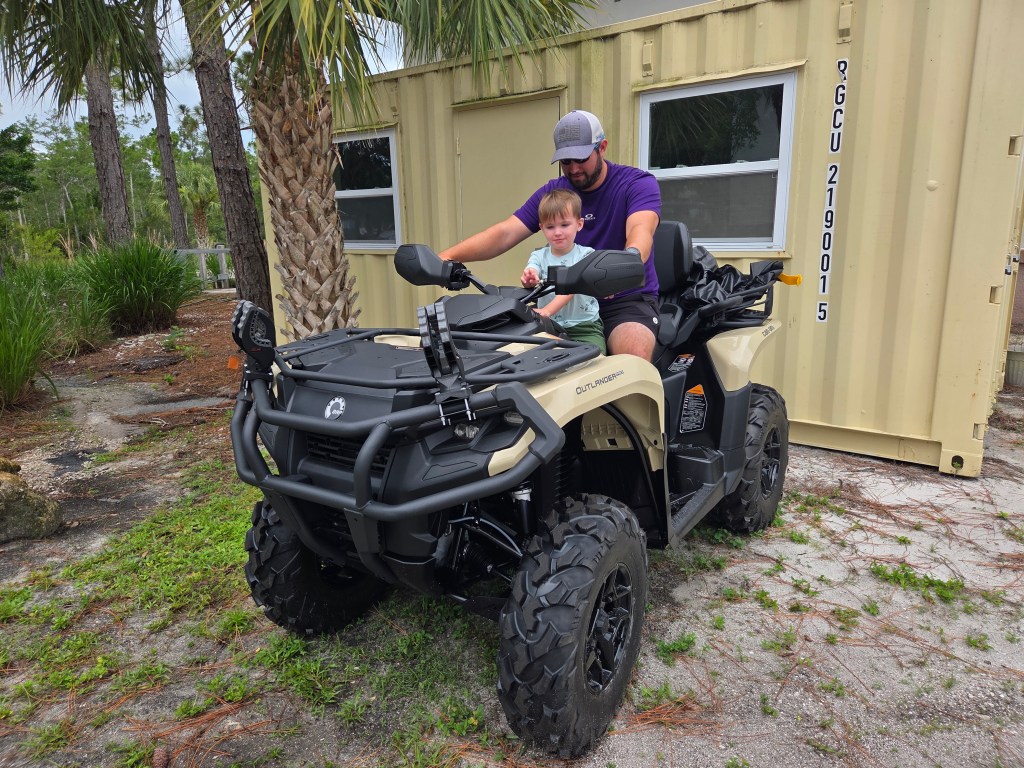
New ATV courtesy of the Florida Sea Turtle License Plate Grant Program
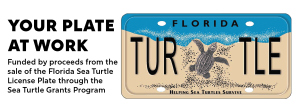
At their March 2026 meeting, the Sea Turtle Grants Committee agreed to fund our proposal for a 2-up Can-Am Outlander Max Pro XU ATV, trailer, and associated safety gear. Learning how to operate an off-road vehicle responsibly is an important step for many students interested in field-based conservation and management careers, and a crucial component enabling students’ Senior Research, Directed Independent Study, and M.Sc. theses. This vehicle will support current and future field activities on Cayo Costa and Don Pedro Island State Parks, Fort Myers and Bonita Beaches, and throughout southwest Florida for years to come!
Now that the vehicle has arrived, training will commence throughout the Fall, Winter, and early Spring getting students comfortable with trailering, off-road vehicle operations, and emergency planning. Keep an eye out for photos from the field, training our next generation of conservationists!
To learn more about the Florida Sea Turtle License Plate Grant Program, check out https://helpingseaturtles.org/.
WE’RE MOVING!
April 2024

Beginning in Fall 2024, I will be starting up a new research lab at Florida Gulf Coast University in Ft. Myers, Florida (https://www.fgcu.edu/). As an Assistant Professor of Conservation Biology in the Department of Biological Sciences, I will continue to study sea turtles as a model species for coastal conservation issues critical to Southwest Florida. This will include both nesting and in-water studies using a range of tools and techniques such as in situ sensor deployments, biologging platforms, drones, satellite remote sensing, GIS, and spatial statistics. However, given the rapid development of this region combined with its tremendous biodiversity, there are extensive opportunities to expand this work to other species and systems such as freshwater turtles, tortoises, alligators, marine mammals, corals, and more!
So, if you are a prospective or current FGCU undergraduate student or are considering a Master’s of Science in Biology and would like to chat about potential project ideas, please do not hesitate to reach out at mware@fgcu.edu! See you all in August!
NEW PAPER RELEASE
KEY ISSUES IN ASSESSING THREATS TO SEA TURTLES:
KNOWLEDGE GAPS AND FUTURE DIRECTIONS
18 December 2023
Hot off the press for the 2023 holiday season is a new paper out in Endangered Species Research offering guidance for the future of sea turtle conservation around the globe. Dr. Mariana Fuentes led a huge team of co-authors to investigate what we know and what we don’t about major current threats experienced by all sea turtle species from the Americas to Asia and everywhere in between. Such threats include:
- Climate change
- Direct take or harvest
- Fisheries interactions
- Pollution
- Disease
- Predation
- Coastal and marine development

Graphic courtesy of Fuentes et al. (2023) and Alexa Putillo.
Understanding how these threats impact sea turtles is important because these animals serve critical ecological and cultural functions. Sea turtles are links in the food web, serving as both predator and prey, and transport nutrients between land and sea and across ocean basins. They maintain the health of nearshore ecosystems including seagrass beds, coral reefs, and sandy beaches. Viewing them in the wild or in aquaria drives a significant tourism economy. And in some cultures, they are key to various religious, social, and homeopathic functions.
Efforts over the past several decades targeting specific threats or locations have been successful, as some populations have shown signs of recovery (e.g., the use of Turtle Excluder Devices [TEDs] to reduce fisheries bycatch in the southeastern United States). However, many threats persist and new ones are emerging. Critically, the paper discusses the need to not only deal with these threats singularly, but in combination as well. Each threat does not operate in a vacuum and understanding interactions between the threats themselves, or management actions taken to address them, will ensure that conservation actions are as effective as possible. This includes a suite of new research techniques such as chemical tracers, genomics, biologging, remote sensing, and machine learning to supply novel insights into animal movement, population connectivity, habitat occupancy and suitability, and levels of threat exposure across local, national, and international boundaries.
To read about each of these threats, conservation approaches currently in use to address them, and knowledge gaps still plaguing their effective management, check out the manuscript at https://www.int-res.com/abstracts/esr/v52/p303-341/.
Fuentes et al. (2023) Key issues in assessing threats to sea turtles: knowledge gaps and future directions. Endangered Species Research 52: 303-341.
DOI: https://doi.org/10.3354/esr01278

PROJECT UPDATE: Wave Exposure of Sea Turtle Nests
Identifying inundation and erosion hot-spots in the Florida Panhandle
10 May 2021
Inundation and nest erosion from wave exposure, storm surge, and sea level rise are major threats to sea turtle nests – causing localized mortality of eggs, as well as potential changes in hatchling size, morphology, locomotor function, and sex. Nesting females use several environmental cues such as beach slope, tide height, and distance from the water to reduce the chances of wave exposure. However, waves are still a common problem and increasing storm intensity and coastal modifications (e.g., seawalls and upland construction) only exacerbate the issue. Identifying where and under what conditions wave exposure becomes a problem, and deciding what action to take (if any), is a common issue for sea turtle managers.

To help managers with this decision, this project used beach elevation data, nest location and productivity data, and wave runup modeling to:
- Identify the reduction in loggerhead sea turtle hatchling production caused by wave exposure
- Map out which beaches in the Florida Panhandle represent priority areas for conservation initiatives

From 2016 to 2019, reported wave exposure affected 42% of loggerhead nesting stretching from the Florida-Alabama state line east to Bald Point State Park – 1,665 nests were washed over and an additional 1,200 nests were either partially or completely washed away. On average, the nests which were washed over produced 46% fewer hatchlings than nests which were otherwise undisturbed. By comparison, predated nests produced 28% fewer hatchlings, on average, than their undisturbed counterparts.
The wave runup model had an 89% accuracy when determining the presence or absence of wave exposure during a nest’s 2-month incubation. When mapped across the Florida Panhandle and considering the number of nests laid per beach, the model suggested the following beaches represent the highest priority for conservation initiatives:
- St Joseph Peninsula State Park
- St Joseph Peninsula
- St George Island
- Cape San Blas
- Cape St George Island
Together, these 5 beaches represent 60% of the loggerhead nesting in the region. Significant losses from wave exposure on these beaches can dramatically affect hatchling production for the entire Northern Gulf of Mexico loggerhead sea turtle population.

There is still a lot of work to be done. This model is just one step in the larger efforts for sea turtle conservation in the Florida Panhandle and elsewhere. For example, before we can consider any management action or intervention ranging from beach preservation to nest relocation, we need to know:
- At what frequency or duration of exposure does wave wash-over cause significant harm to developing turtles?
- Do these exposure thresholds vary with the developmental stage of the embryo?
- How does this tolerance (or lack thereof) vary across species and populations?
- What are the benefits of non-lethal levels of wave exposure, including reduced incubation temperatures, increased male hatchling production, large body sizes, and/or faster crawling speeds?
- Would relocating nests introduce other threats which may cause as much (or greater) impact than wave exposure in their current location, such as hyperthermia, increased female hatchling production in a female-dominant population, desiccation, and increased predation or orientation?
- How is wave exposure likely to change in the near future due to coastal development, armoring, beach erosion, hurricane frequency and strength, and sea level rise?
- How may sea turtles naturally adjust their nesting behaviors to combat these changing beach conditions?
Certainly plenty to keep us busy for awhile, so stay tuned for updates from the sea turtle community! The manuscript for this work was published in the special section “Remote Sensing Applications for Sea Turtle Conservation” in the journal Remote Sensing. Check it out at https://www.mdpi.com/2072-4292/13/14/2654!
Ware et al. (2021) Exposure of loggerhead sea turtle nests to waves in the Florida Panhandle. Remote Sensing 13(14): 2654.
DOI: https://doi.org/10.3390/rs13142654
For similar work, check out:
Ware et al. (2019) Using wave runup modeling to inform coastal species management: An example application for sea turtle nest relocation. Ocean and Coastal Management 173: 17-25. DOI: https://doi.org/10.1016/j.ocecoaman.2019.02.011.
https://www.sciencedirect.com/science/article/abs/pii/S0964569118310202
This project was funded in whole by a grant awarded from the Sea Turtle Grants Program, grant number 20-015R: http://www.helpingseaturtles.org/funded.php?year=2020. The Sea Turtle Grants Program is funded from proceeds from the sale of the Florida Sea Turtle License Plate. Learn more at www.helpingseaturtles.org.

